Emergency Power Systems in Hospitals: D.C. Permit & Inspection Rules
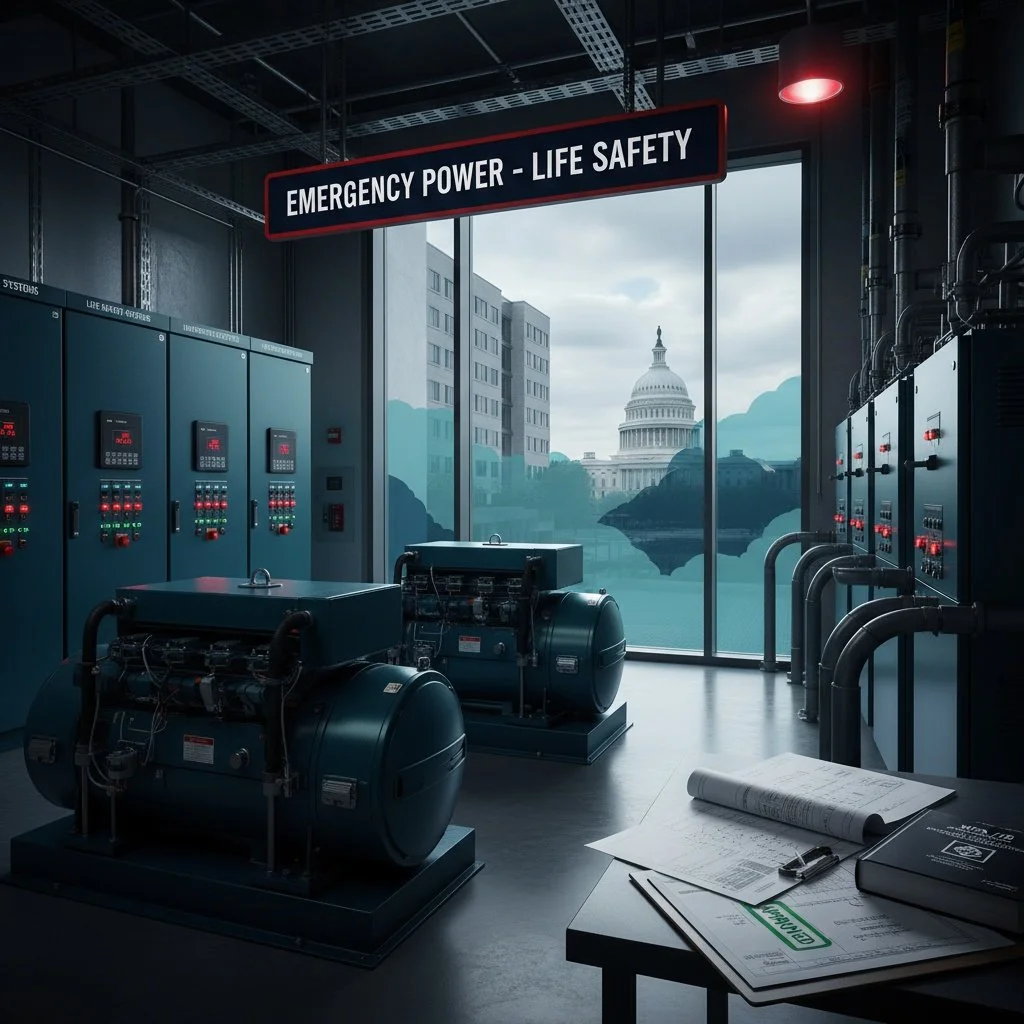
When the grid fails, your facility can’t. But in Washington, D.C., installing or upgrading an emergency generator isn’t just about power; it’s about permits, code compliance, and inspection readiness.
Emergency Power Is the Lifeline Hospitals Can’t Afford to Get Wrong
From operating rooms to ventilators, critical systems in hospitals depend on a seamless transition to emergency power during outages. But ensuring those systems are compliant, permitted, and approved is a complex regulatory process in D.C.—and one you must navigate before the first bolt is tightened.
If you're managing or upgrading an emergency generator system in a Washington, D.C. hospital or healthcare facility, here’s what you need to know to avoid delays, violations, or inspection failures.
🔌 1. Building Permit First—Always
You can’t pull an electrical permit for a generator installation without an approved building permit. Period.
In D.C., all major trade work must begin with a full building permit application through the Department of Buildings (DOB). That includes emergency generators, transfer switches, fuel systems, and enclosures. Trade permits (electrical, mechanical, plumbing) cannot be pulled independently for this type of installation.
Your building permit submission must include:
Site plans or generator location drawings
Architectural and structural details (pad, supports, enclosures)
Electrical plans showing load distribution, panel schedules, ATS
Mechanical specs for cooling, exhaust, or HVAC tie-ins
Plumbing/fuel line drawings (if applicable)
Equipment data sheets and code references (NFPA, NEC)
Once the building permit is approved, you may then pull the necessary trade permits.
💬 “In D.C., emergency systems aren’t just reviewed in isolation. They’re part of a complete building compliance process, and trade permits only come after the master permit is issued.” — Marcus Grant, Healthcare Permitting Advisor
⚡ 2. Compliance with National Fire and Life Safety Codes
If your generator doesn’t meet NFPA, it won’t pass inspection.
Washington, D.C. adopts and enforces the following codes for emergency power systems:
NFPA 70 (National Electrical Code)
NFPA 99 (Health Care Facilities Code)
NFPA 110 (Emergency and Standby Power Systems)
NFPA 101 (Life Safety Code)
These standards determine:
Generator type and runtime duration
Classification of transfer switches
Circuit separation between life safety and standby loads
Testing requirements (weekly, monthly, annual load tests)
Location and physical protection of fuel systems and wiring
Pro Tip: Include these code references in your plan notes. DOB reviewers and inspectors will expect them.
🛢️ 3. Fuel System Triggers DOEE and Fire Review
More fuel = more regulation.
If your generator is diesel- or gas-powered and includes new or modified fuel storage, it will trigger review from:
DOEE (Department of Energy & Environment): For above- or underground tank registration, emissions compliance, and stormwater runoff
D.C. Fire & EMS: For fire rating of fuel room, spill containment, and emergency shutoff access
EPA Tier Rating Requirements for emissions and noise (depending on generator size)
Generators near property lines or in dense urban areas may also require Public Space Permits or noise mitigation reviews.
📊 Stat: Emergency power projects in D.C. with fuel storage take an average of 4–6 weeks longer due to interagency reviews.
🧰 4. Don’t Forget the Load Calculations and Essential System Design
Inspectors want proof that your generator can handle the job—exactly the job.
In hospitals, generators don’t serve everything—they serve essential systems only. NFPA 99 classifies them into:
Life Safety Branch: Egress lighting, fire alarms, communication
Critical Branch: Patient care-related electrical loads
Equipment Branch: HVAC, elevators, medical support
Your design must:
Match generator capacity to connected loads
Use dedicated Automatic Transfer Switches (ATS) for each branch
Show compliance with selective coordination requirements
Provide isolation from non-essential circuits
Pro Tip: Submit your load calculation sheet and breaker coordination study with your plans. Missing this step is a top reason for DOB rejection.
🧪 5. Testing & Inspections: Prove It Works Before You Go Live
Before your system is operational, it must pass:
Electrical inspection (rough and final)
Mechanical inspection (if ventilation or cooling is added)
Plumbing inspection (for fuel system tie-ins)
DOB special inspection (for anchorage, vibration, seismic compliance)
Load test: Often observed live by DOB or third-party inspectors
Transfer test: Verifies ATS performance under real-time switching
For licensed hospitals, these results must be documented for CMS surveys and DOH life safety inspections.
💬 “Failing a final inspection because the generator can’t transfer or carry the load? That’s more common than you think—and it shuts projects down cold.” — Alicia Vega, Commissioning Agent
🔁 6. Upgrading or Replacing an Existing Generator? You Still Need Permits
Even if you're doing a like-for-like swap, you're required to:
Apply for a new building permit
Submit updated load studies and equipment specs
Confirm fuel and emissions compliance
Pass full inspection and testing before reactivation
Skipping these steps can invalidate your Certificate of Occupancy and violate your DOH license.
🧾 D.C. Emergency Generator Permit Checklist for Hospitals
✔ Submit full building permit with coordinated trade plans
✔ Include generator specs, pad/enclosure details, and load studies
✔ Apply for trade permits (E, M, P) after building permit approval
✔ Coordinate with DOEE for fuel/emissions if applicable
✔ Schedule load and transfer switch testing
✔ Document for DOB, CMS, and DOH audits
Final Thoughts: Don’t Let a Generator Project Short-Circuit Your Operations
In a hospital, emergency power isn’t optional—it’s mission-critical. But in D.C., it’s also highly regulated, and the permitting process must be followed precisely.
From generator sizing and structural pads to exhaust routing and fuel permits, every detail matters. Start with a solid plan, get the right permits in place, and partner with experts who understand the code inside and out.
Need Help Permitting a Hospital Generator in D.C.?
M.C.G. Permit Consultants helps healthcare facilities across Washington, D.C. navigate the full generator permitting process—from building permit to final load test. Let us help you avoid red tape and power up with confidence.
📞 Call: 202-729-8272
📧 Email: sayhello@mcghealthcarepermits.com
🌐 Visit: www.mcghealthcarepermits.com
From emergency power to life safety compliance—we help you get it right the first time.
